

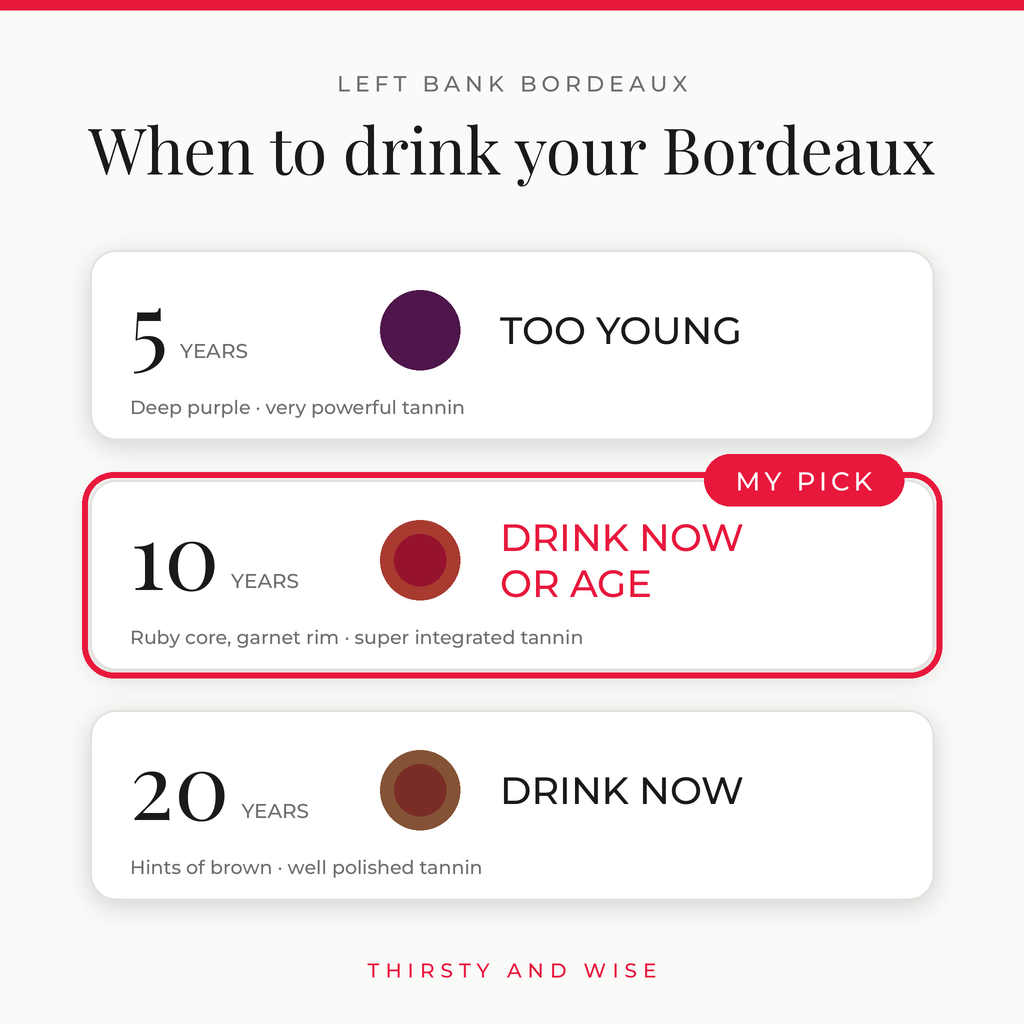
In this case, my answer is: at 10 years. Here is how I got there, after tasting the same top Bordeaux producer at 5, 10 and 20 years in the bottle.
The producer was classified in the 1855 classification, so we know it comes from the Left Bank of Bordeaux. The Left Bank is dominated by Cabernet Sauvignon.
At 5 years: outstanding, but too young
The first wine has a deep purple colour. On the nose it is pronounced and well defined: fresh, perfectly ripe black fruit, black cherries and cassis. There are some secondary notes of cedar, a little graphite and a little bell pepper. No indication of tertiary character yet.
On the palate the wine is dry, with high acidity and very powerful tannin that needs a little bit of age. The flavours are pronounced and dominated by primary fruit.
The wine is outstanding, but too young.
At 10 years: drink now, or keep ageing
The second wine has a ruby core with a garnet rim. The nose is pronounced and much more complex than the five-year-old: black fruit, black cherries and cassis, with much less of that bell pepper, herbaceous character. There are secondary notes of toast and cedar, and a beautiful tertiary development of chestnut, forest floor and a little dry tobacco leaf.
On the palate there is high acidity and super well integrated tannin. It is a powerful wine with a long finish, beautifully balanced between primary, secondary and tertiary character.
You can drink it now, but it still has potential for ageing.
At 20 years: drink now
The third wine is deep, but with hints of brown. On the nose it is completely tertiary. There is a hint of black fruit, toast and some cedar, but the wine has moved fully into dry tobacco leaf. Very complex.
On the palate there is high acidity, and the tannin is well polished and well integrated. Pronounced and complex.
For me, this one is drink now. Today!
So: When to drink Bordeaux? My verdict…
Honestly, out of all three, I would drink my Bordeaux when it’s 10 years old: balanced between primary, secondary and tertiary character, ready to drink now, with potential for more ageing.
Studying for WSET Level 3 in Wines?
Deciding whether a wine is too young, ready to drink or still able to age is exactly the kind of conclusion you need to make in a Level 3 tasting.
Need help with Level 3?
We simplify it in our Level 3 Wine Study & Support Program. Want to see how first? Join one of our Level 3 Live Study Rooms, where we tackle the most challenging part of the exam: the short written answers.
Stay Thirsty and Wise!
Our Level 3 study tools are independent study resource, not affiliated with or endorsed by WSET.

